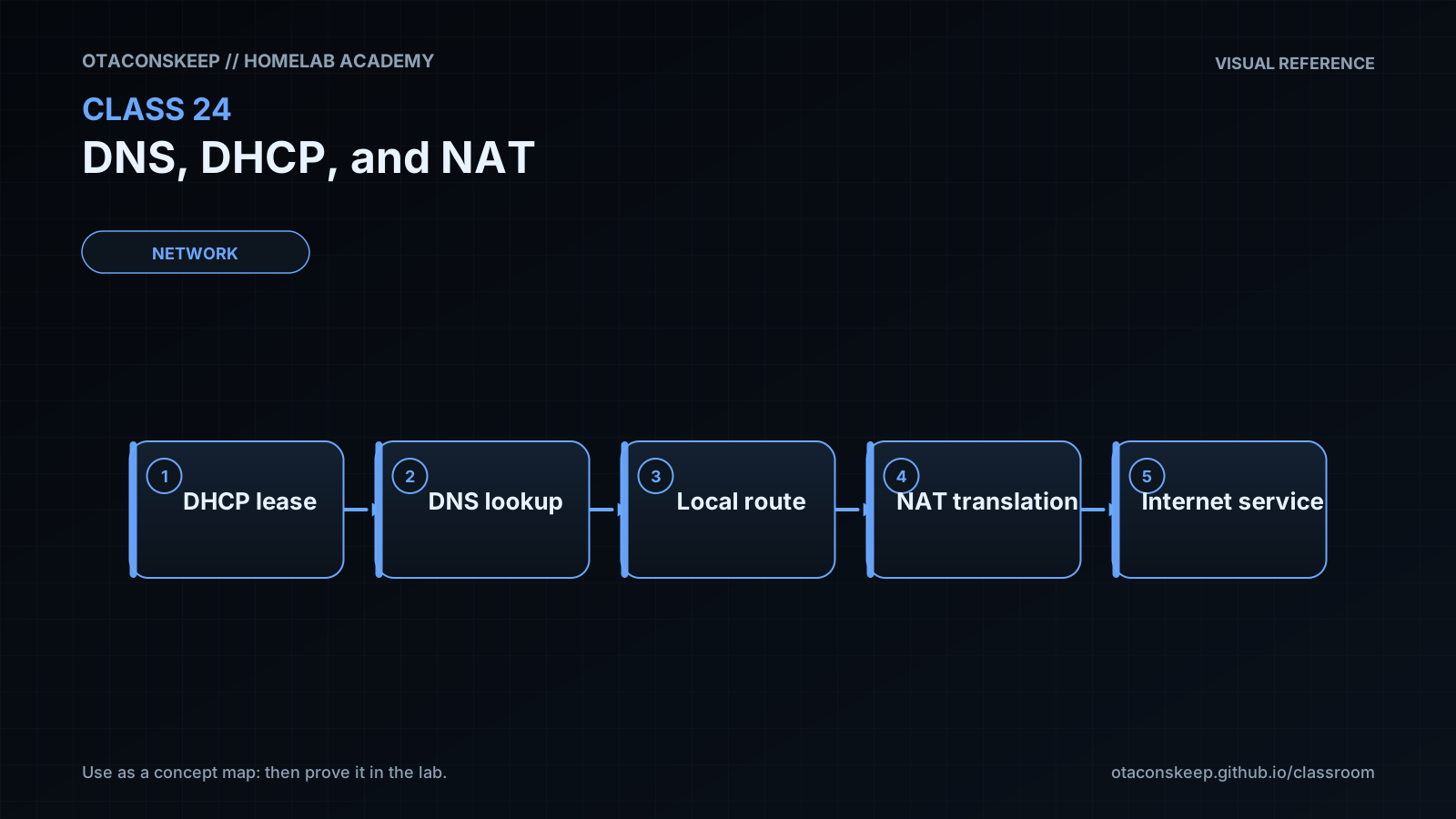
Overview
Module: Network Operations
Activity type: Quiz / retrieval practice
Target: ≥80%
Objective: Describe the separate responsibilities of DNS, DHCP, and NAT
Learn
Questions
In plain words: Read this block, then try the next action. If you feel stuck, tap What this means.
-
- What four messages are represented by the DHCP DORA mnemonic?
-
- Which DHCP-supplied setting tells a client where to send traffic for destinations outside its local subnet?
-
- What is the difference between a recursive DNS resolver and an authoritative DNS server?
-
- Why can an old DNS answer remain visible after an authoritative record has changed?
-
- Why does PAT usually track transport ports in addition to IP addresses?
-
- Does a successful DNS lookup prove that the named application is reachable? Explain.
-
- Why should NAT not be described as a complete security policy?
-
- What is the practical difference between a DHCP reservation and manually assigning a static address on a client?
-
- What problem can occur when two interconnected sites use the same private IPv4 subnet?
-
- In the lab, why does the second request from client-a return 192.168.24.100 instead of consuming the next pool address?
In plain words: NAT lets the guest use the host’s internet path. The guest is usually not a full peer on your home LAN.
Learn
After scoring
In plain words: Read this block, then try the next action. If you feel stuck, tap What this means.
- Missed items → return to Reading → redo Feynman Retry → reattempt.
In plain words: Big idea: - Missed items → return to Reading → redo Feynman Retry → reattempt.
In plain words: Home Assistant watches sensors and runs if-this-then-that rules for your house.